āta Verified Regenerative Services
Land to Market
What is Land to Market™?
The era of greenwashing and shopper doubt is coming to a close. For the first time in history, we can let consumers know a product’s impact on the environment, with empirical data to back it up, then highlight those products that are having a net-positive impact on the land, and thus empower individuals to vote with their food dollar like never before.
The Land to MarketTM (L2M) programme is just as it is named. It connects the produce from regenerating land to conscious consumers globally. The Savory Institute has been helping land managers regenerate their grass land over the last 50 years, but the work these producers did, and the produce of that land was not effectively differentiated for consumers who cared.
But, in recent times, the increasing consumer awareness of the impact of industrialised farming on ecology, climate and health has been heard by some concerned brands. These brands under the stewardship of the Savory Institute created Land to MarketTM to bring these consumers closer to the farmers who were regenerating their land.
Land to MarketTM is the world’s first regenerative verification and sourcing solution.
Ultimately, we want this voice of the land to speak directly to consumers and empower them with more information and allow them to be able to play a role in environmental regeneration through their purchasing decisions.
Regenerative agriculture provides solutions to critical issues such as food security, desertification, climate change, water scarcity, decreasing nutritional quality and degenerating health.
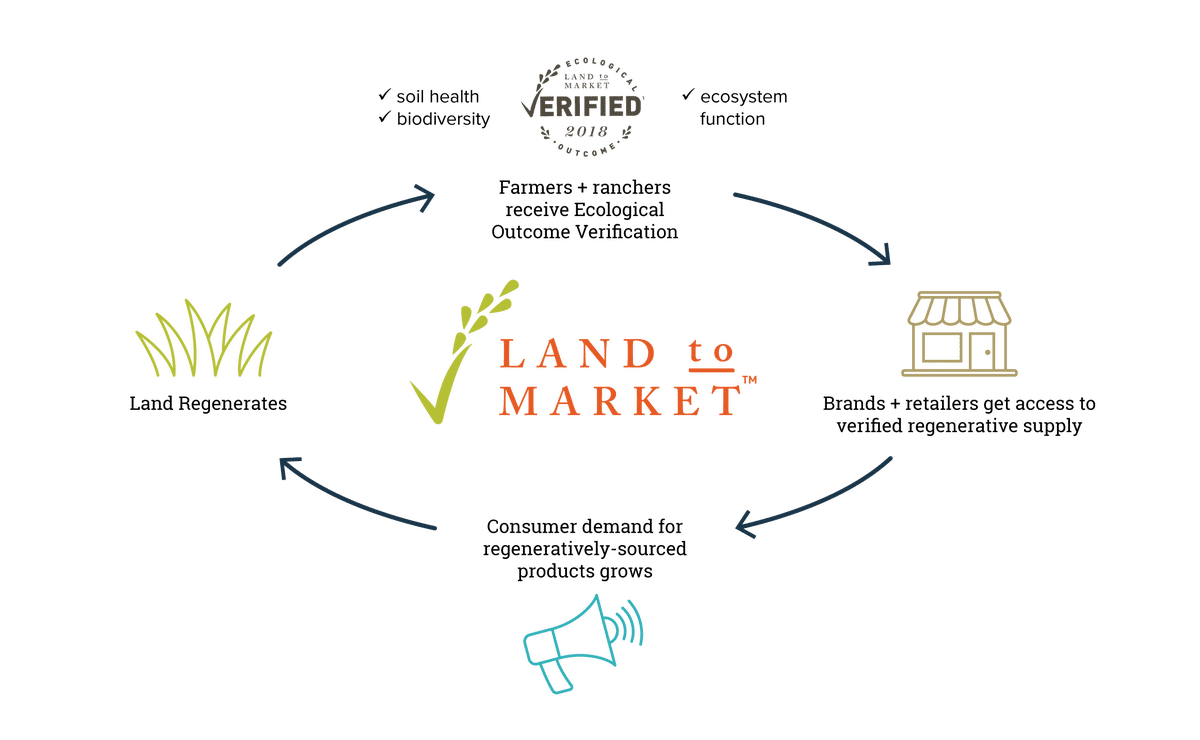
It recognises farmers for positive ecological outcomes, offers sourcing solutions for retailers and brands and empowers consumers through their purchasing power.
Why do we need Land to Market?
Land to MarketTM is creating a whole new opportunity for consumers to play an active role in healing the environment. This scientifically-based verification takes assumption out of the equation and quantifies actual outcomes on the land. This programme dovetails beautifully with existing practice-based certifications such as organic, grassfed and grass-finished, and welfare programmes – but it fills a gap in the marketplace of measuring what actually happens on the land as a result of how livestock are managed.
Ecological Outcome VerificationTM is the outcome-based scientific protocol central to Land to MarketTM used to measure land regeneration and makes Land to MarketTM a global solution to climate change.
Land based production of food and fibre has degraded billions of hectares of land world wide with degradation of grasslands contributing directly to climate change.
Grasslands cover 30% of the worlds surface and offer the opportunity to store massive quantities of carbon when managed with regenerative principles. Loss of these grasslands contributes to famine, drought, floods, poverty and poor health.
In New Zealand poor management of land causes serious erosion, loss of topsoil, drought, floods degrading animal health, loss of biodiversity and economic harm.
Who is involved?
We have begun partnering with some of the most conscientious, forward-leaning brands in the regenerative agriculture arena.
For properties achieving regenerative outcomes, Land to MarketTM deals with everything transactional and verifies the integrity of both product and communications through the supply chain and in the marketplace.
Farmers and producers of meat, dairy, wool and leather are at the source. The programme has also input from Savory Hubs, soil scientists, agronomists ecologists, Savory business coaches, retail partners, institutional supports and aligned certification groups.
The conscientious, forward-leaning brands supporting the Land to Market programme as Frontier Founders include leading global brands.
The Global Savory Network is a network of hubs that offer Holistic Management training, consulting, learning, verification, accreditation and monitoring.
āta Verified Regenerative is the accredited Savory Hub for New Zealand. We are able to assist with your regenerative journey from initial measurement, to developing a regenerative programme which fits your context, to Ecological Outcome Verification and ongoing management.

What is Ecological Outcome Verification?
Ecological Outcome VerificationTM (EOV) is a scientific protocol developed by the Savory Institute in collaboration with Michigan State University, Texas A&M, Ovis 21, The Nature Conservancy, and others.
It verifies land health and performance by considering over two dozen different data points, across a wide spectrum of leading and lagging indicators.
Variables that get measured include soil health, water infiltration rates, biodiversity, and ecosystem function. It’s the first of its kind, being entirely outcomes-based and utilising empirical data to back up regenerative claims.
EOV will help farmers to unleash unrealised potential within their land and allow them to implement new strategies that are specific to their individual context.
Producers can only thrive with short and concise feedback loops that tell them as quickly as possible if their innovation is taking them in the right direction.
The only way to accomplish all of this is to shift the focus to outcomes rather than prescriptions.
How does EOV differ from other programs?
EOV encompasses a much larger scope than just carbon. While carbon is the doorway in which many are entering the regenerative space, there are a multitude of reasons to include a broader range of measurements which demonstrate a stronger indication of overall environmental health, while simultaneously building a stronger carbon model.
Most certifications are based on input controls and audits of inputs; prequalification and lists of dos and don’ts. With input control there is no surety that this leads to change in outcomes; EOV measures only outcomes. There is no prequalification with EOV and no requirement to achieve anything more than constant improvement of ecological health. This status of constant incremental improvement allows the producer to use the EOV Mark on produce from that land base and participate in the global Land to MarketTM programme.
EOV is driven by farmers and producers at grassroots level. It is not a top down system. Farmers and producers learn through leading indicators of ecosystem function, how to read their land quickly and pivot management accordingly through shorter feedback loops. It also provides an annual report that shows how their land is trending – is it getting healthier? more resilient? regenerating or degenerating?
We, as a society, must go beyond sustainability and we must create net positive impacts in all of our endeavours, particularly in agriculture.
āta Verified Regenerative is the only certified Ecological Outcome Verification provider in New Zealand
Frequently Asked Questions on Land to Market
What is Land to Market™?
Land to Market™ is the world’s first verified regenerative sourcing solution, developed by the Savory Institute. It connects consumers and brands to products that come from land proven to be regenerating, improving soil health, biodiversity and ecosystem function through measurable outcomes.
What is regenerative farming in New Zealand?
Regenerative farming in NZ focuses on rebuilding soil health, increasing biodiversity, improving water cycles and creating resilient farms. It goes beyond sustainability, aiming for a net-positive impact on the environment, local communities and food systems.
How does Ecological Outcome Verification™ (EOV) work?
EOV is a scientific monitoring process that measures land health using real-world ecological data, such as soil carbon, water infiltration and biodiversity. If the land shows consistent improvement, it becomes verified regenerative under the Land to Market™ programme.
What’s the difference between regenerative and organic farming?
Organic farming focuses mainly on eliminating synthetic inputs, while regenerative farming measures outcomes, soil health, carbon storage and ecosystem restoration. Many regenerative farms are also organic, but regeneration goes further by improving natural systems.
Who can join the Land to Market™ programme?
Any farmer, producer or brand committed to regenerative agriculture can join. ĀTA Regenerative, the Savory Hub for New Zealand, provides local support, EOV assessments, training and verification guidance to help producers achieve Land to Market™ status.
What products can be Land to Market™ verified?
Products such as meat, dairy, wool, leather and wine can carry the Land to Market™ seal once sourced from verified regenerative land. This gives consumers confidence that their purchase is actively helping to restore ecosystems.
Why is regenerative verification important?
Verification ensures that claims of “regenerative” are backed by science, not marketing. Through EOV data, brands and farmers can demonstrate measurable improvements in soil carbon, biodiversity and land function, providing transparency and credibility to consumers.