

This article is part of my El Niño Preparedness Series. Before reading, I recommend starting with Article 1: Preparing for El Niño: Introduction to new series – What nine years of EOV monitoring show
How animal management can build water resilience in New Zealand’s pastoral landscapes
| We cannot control how much rain falls, but through the management of grazing animals we can influence how much enters the soil, how long it remains available and how quickly it leaves the farm. |
As New Zealand prepares for a potentially strong El Niño, farmers are again considering how their businesses will manage drought, intense rainfall and increasing climatic variability. The likely effects will not be uniform: eastern areas commonly face greater drying risk during El Niño, while western areas may experience wetter and more unsettled conditions. Resilience is therefore not simply about preparing for less rain. It is about enabling land to function through both scarcity and excess.
The soil beneath every farm has an inherent capacity to receive, store and cycle water while supporting plant and animal production. Too often, however, that potential remains unrealised. The limitation is not always the soil itself; it is frequently the conditions created by the way the land is managed.
In pastoral agriculture, animals are the most important and responsive management tool available to us. Where they graze, how long they remain, the impact they create and the recovery allowed afterwards all influence vegetation, soil structure, biological activity and the movement of water through the landscape.
The same animal can create very different outcomes
Animals are neither inherently damaging nor inherently regenerative. Under one form of management, repeated grazing, excessive removal of cover or treading vulnerable wet soil can contribute to compaction, declining plant vigour, bare ground, runoff and erosion. Under different management, animals can stimulate plant growth, cycle nutrients, place plant material in contact with the soil and help maintain a diverse, well-covered pasture.
The outcome depends on timing, duration, frequency and recovery. It also depends on soil moisture, slope, soil type, animal class and seasonal conditions. A management decision that produces a beneficial effect in one place or season may be damaging in another.
For this reason, regenerative grazing should not be reduced to a fixed rotation, a particular stock density or a branded grazing method. The principle is to manage animal impact in response to the condition and needs of the land and then monitor whether ecological function is improving.
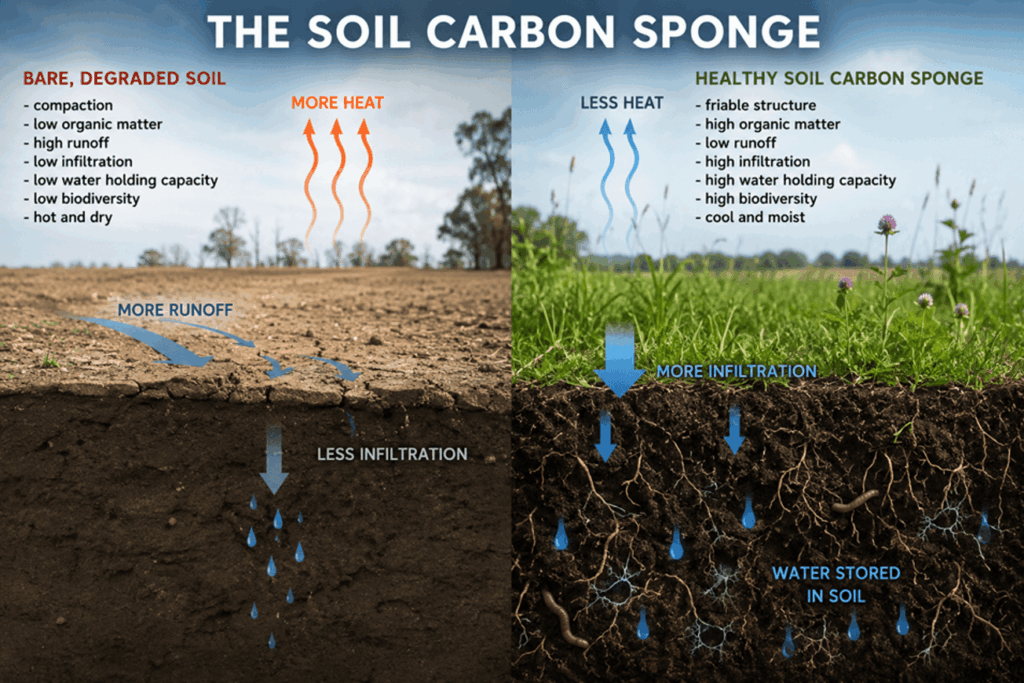
Image adapted from Walter Jehne
What nine years of EOV monitoring is showing us
For nine years, Āta has used Ecological Outcome Verification (EOV) to monitor changes in the ecological function of New Zealand farms. The programme measures water infiltration directly, together with ground cover, bare ground, plant diversity and other indicators of landscape health. Our soil testing also measures soil moisture across multiple monitoring sites.
Together, these measurements allow us to examine more than how much rain a farm receives. They show how effectively the land accepts rainfall and how moisture is retained across the monitored landscape. We can then relate changes in water function to changes in animal and grazing management over time.
Across many monitored landscapes, we are seeing a concerning direction of travel: falling pasture cover, increasing bare ground, declining plant diversity and increasing soil compaction. We are also seeing a loss of biological activity and life within the soil. These changes weaken the conditions needed for effective water infiltration and retention. Compaction closes pore spaces and restricts the movement of water, air and roots through the soil profile. With less vegetation protecting the surface, rainfall strikes the soil with greater force causing ‘capping’. Water moves across the land more readily, erosion risk increases and exposed soil loses more moisture through evaporation.
Where regenerative management principles are being successfully applied, we see a different trajectory: greater and more persistent cover, less bare ground, improving plant diversity, stronger infiltration and better retention of soil moisture. With changes in grazing management, we also see compaction begin to reverse and biological activity return, rebuilding the pore structure through which water and roots can move. There is less evidence of runoff and erosion. This does not make a farm immune to drought or flood, but it improves the land’s capacity to endure disturbance and recover.
From rainfall to effective rainfall
A rain gauge tells us how much water reached the farm. It does not tell us how much entered the soil or remained accessible to plants. Effective rainfall is the portion that infiltrates, is retained within the landscape and remains available to support biological and agricultural production.
Two neighbouring farms or two paddocks on the same farm can receive the same rainfall and obtain very different value from it. Where the soil surface is protected, plant roots are active and soil structure is functional, more water has the opportunity to enter. Where the surface is bare, sealed or compacted, a greater proportion may pond, run off or carry soil and nutrients away.
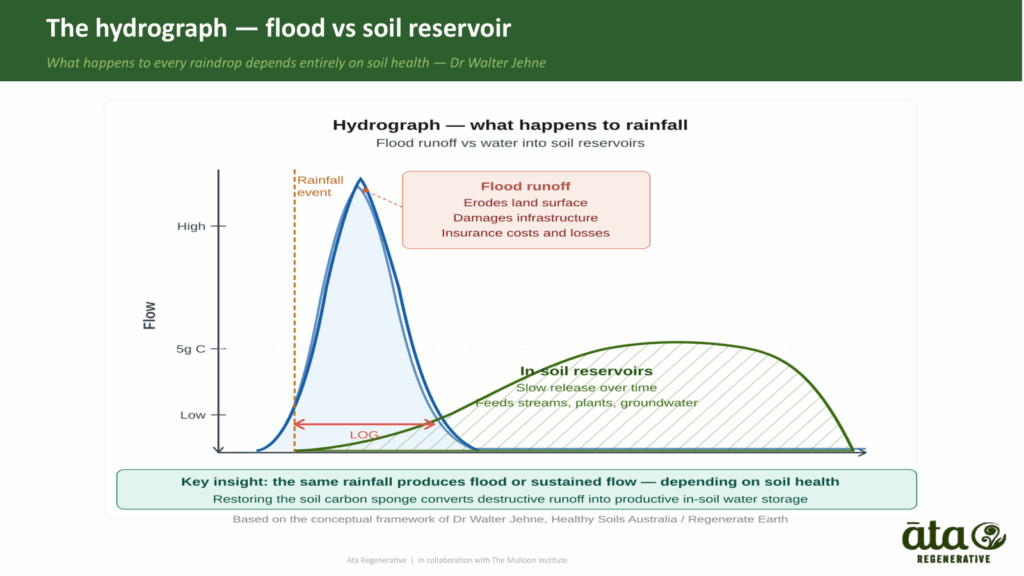
Image adapted from Walter Jehne
Principles for managing animal impact
There is no single grazing prescription suitable for every farm. The practical opportunity is to work from principles and adjust management in response to observed conditions.
- Protect the soil surface. Retain enough living vegetation and litter to soften raindrop impact, reduce evaporation, slow surface flow and protect soil aggregates.
- Allow plants to recover. Judge recovery from plant growth and condition rather than a fixed number of days. As growth slows, recovery periods generally need to lengthen.
- Manage time as well as numbers. Long occupation can allow preferred plants to be grazed repeatedly. Frequent return before recovery can progressively reduce leaf area, root activity, cover and diversity.
- Match animal impact to soil conditions. Concentrated or prolonged treading on saturated and vulnerable soils can close pore spaces, reduce infiltration and create pathways for runoff.
- Use impact purposefully. Stock concentration and movement can help cycle nutrients and manage pasture structure, but density alone is not regenerative. Its value depends on timing, duration, conditions and recovery.
- Respond early. When plant growth slows, adjust recovery, grazing demand and livestock plans before protective cover and plant reserves are depleted.
Read the response of the land
The most useful guidance comes from combining observation with measurement. Farmers can ask: Is ground cover rising or falling? Is bare ground increasing in particular paddocks or landscape positions? Are plants fully recovered before animals return? Is diversity broadening or narrowing? Does rain enter the soil or begin to move across it? Which paddocks hold moisture and continue growing longest as conditions dry? Is erosion becoming more or less evident?
EOV strengthens this feedback by measuring the ecological outcome over time. Management is the intention; the response of the land tells us whether that intention is being realised.
| A weather forecast tells us how much rain may fall. Ecological monitoring tells us how effectively the land can use it. |
The most important place to begin
Grazing management is not the only influence on farm hydrology. Trees, wetlands, waterways, cultivation, cropping and the physical design of the landscape also affect the movement and retention of water. Each offers important opportunities for building resilience and deserves consideration in its own right.
For pastoral farmers, however, animal management is the tool used most frequently, across the greatest area and with the most immediate capacity to alter ecological function. It is therefore the logical place to begin.
Resilience to drought and heavy rainfall is not created when the forecast becomes urgent. It is built progressively through daily decisions about plant recovery, soil protection and animal impact. Those decisions influence whether rainfall is captured or lost, whether soil remains in place or erodes, and whether plants retain the capacity to recover when favourable conditions return.
The land has greater productive and ecological potential than is often expressed. Our role as managers is to create the conditions that allow more of that potential to be realised. Hydrology is where that process begins and in pastoral farming, animals are our most powerful tool for influencing it.
Context: Earth Sciences New Zealand reported in July 2026 that El Niño had developed and could reach strong intensity. Its effects will vary across the country.
Is your land ready for what’s coming?
The principles in this article are ones Āta Regenerative works through directly with farmers using Ecological Outcome Verification. EOV measures water infiltration, ground cover, bare ground, plant diversity and soil moisture across your farm over time, giving you the feedback loop that turns good management intentions into measurable outcomes.
Learn more about EOV and how it can work for your farm. Get in touch with us to explore how we can help you understand your land, measure what’s working, and build a more resilient farm system.